The prompting path · 05 · Method
A one-shot in twelve lines
The path is a sequence, not a better adjective. Twelve lines are enough to see if the story is actually there.
This is the path the other essays are steps on. You can start here and walk back when a picture fails for a reason that now has a name.
A one-shot, in this journal, means a short scene with a turn. Not a chapter. Not a world. Someone does an ordinary thing. Something small changes. The last panel knows about the first.
Write twelve lines before you generate anything. Lines, not paragraphs. If a line needs a paragraph, the scene is still vague.
What the twelve lines are
1. Premise. One sentence, present tense, with a change inside it. Not a theme. “She sits down for a minute and stays long enough that the light leaves the table.”
2. Lock. The paragraph from the second essay, copied, not improved.
3. Place. Reused in every panel the way the lock is reused. “A small kitchen. One table, one window on the right, one door in the back. Noon.”
4–12. Nine beats. Each beat is one shot plus one fact. You are not writing dialogue yet. You are writing the cut.
A shape that fits those nine beats: establish the place, empty of action. She is in it, doing the ordinary thing. A detail the ending will need. The ordinary thing continues — do not rush. The turn, shown as a physical change, not a face labeled shocked. A held still, almost the same framing as the panel before. A consequence, small. A button that answers line 1. The wide matches the opening, or it deliberately does not.
Nine is not a law of drama. Four panels can be a one-shot. Twelve lines is a ceiling for this exercise, so you finish.
1. She sits down for a minute and stays long enough that the light moves off the table.
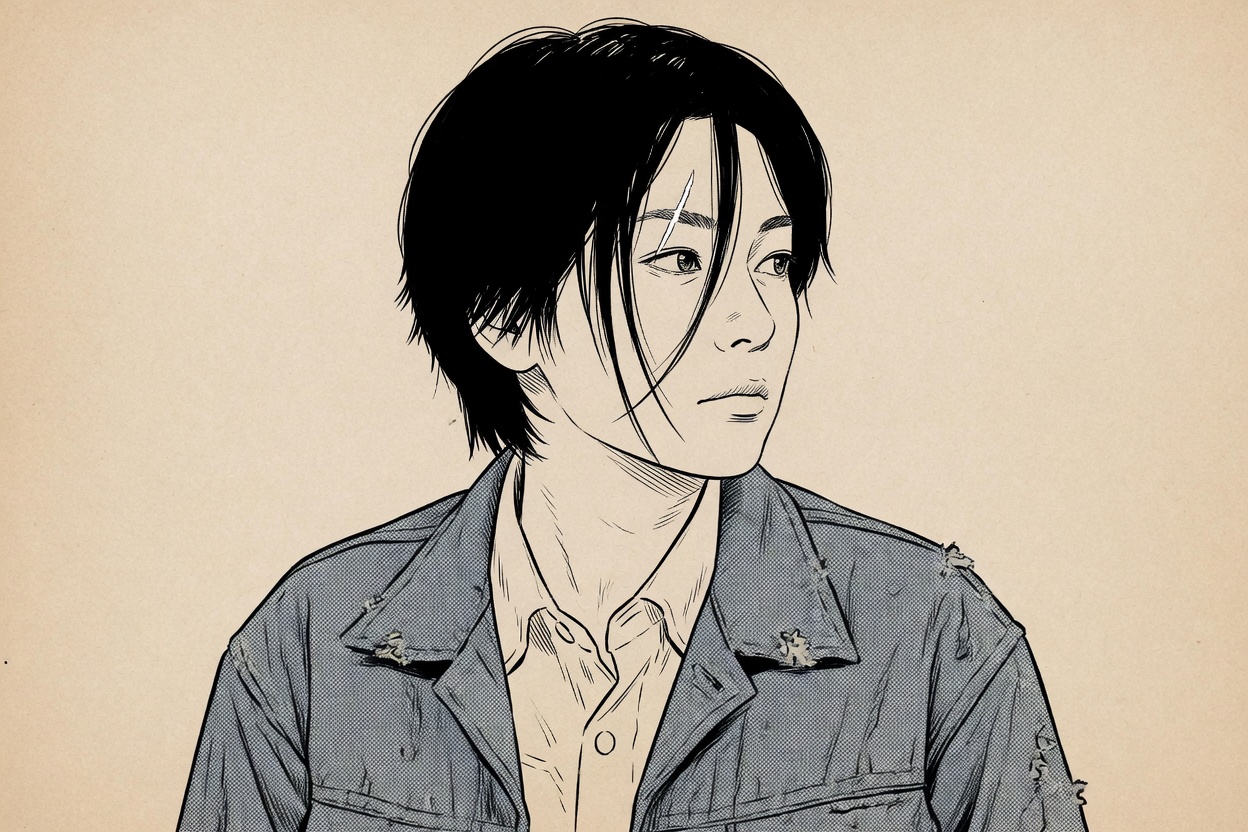
2. Woman in her early thirties, short uneven black hair with one strand over the left eye, a small scar through the left eyebrow, indigo work jacket, white shirt.
3. Small kitchen, one table, window on the right, door in the back. Noon becoming late noon.
4. Wide: the kitchen empty, light hard on the table, door closed.
5. Medium: she sits, jacket still on, both hands around a cup.
6. Close: the cup, and the edge of the jacket cuff.
7. Medium: she looks toward the window, not at us. Same seat.
8. Close: her hand lets go of the cup.
9. Medium, slight high angle: she leans back. The window's shadow has reached the cup.
10. Same framing as 9. She has not moved. The shadow covers the cup.
11. Medium: she stands. The chair is slightly out from the table. No motion lines.
12. Wide, same as 4: the kitchen empty again, the cup left on the table, the light gone from it.
Then one panel at a time
Each generation gets line 2, line 3, and exactly one beat. Write the shot and the empty space the way the first essay asks. Decide the tone the way the third essay asks. No lettering, and no neighboring panel inside the prompt, the way the fourth essay asks.
An original woman in her early thirties. Short uneven black hair, one longer strand over her left eye, a small scar through the left eyebrow. Worn indigo work jacket over a plain white shirt. Keep this face, this hair, and this jacket the same.

Small kitchen: one table, one window on the right, one door in the back. Noon.

She sits at the table, jacket still on, both hands around a cup. Medium shot, eye level. Hard light from the window on the right. The left third of the panel is empty table. Manga ink line, printed halftone only on the jacket. No lettering, no speech balloons, no speed lines.
Do not regenerate the whole sequence because one panel was the best. Save that one. Fix the line that failed. A path is allowed to be uneven. It is not allowed to forget the face and the room it started with.
When the pictures sit in a row, read them without the lines in front of you. If you can tell that time moved and that she left, the path worked. If you need the captions, the shots were not doing the telling. Change the beat’s shot. Leave the adjectives alone.
Twelve lines fit on one sheet of paper. That is the point.
If the scene cannot be held on one sheet, you are not ready to spend a dozen generations on it. Shrink the change until it fits, then prompt.